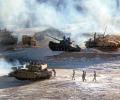
India's national security strategy needs to be revised periodically since the global and regional geopolitical situation is dynamic, points out Commodore Venugopal Menon (retd).
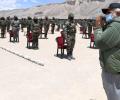
'By not even acknowledging China's occupation of Indian territory Modi signalled to Beijing that he was not prepared to used forceful means to vacate the Chinese occupation, and that his government was reconciled to this loss of territory and accepted the fait accompli engineered by the PLA.'

'Bolstering India's conventional military capability against China is in America's strategic interest,' says military historian Colonel Anil A Athale (retd).

Bharatiya Janata Party's prime ministerial candidate Narendra Modi's belated attempt to project himself as a statesman and a man of reason in his interviews to ANI and TV9 is being viewed with dollops of scepticism by his critics and political opponents. Anita Katyal reports.
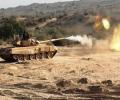
'It is ironic that General Rawat, an infantry officer who the government chose because of his expertise in counter-insurgency, has made his first bold statement in the realm of warfighting and mechanised operations,' points out Colonel Ajai Shukla (retd).

'It is strange that a country like India, which had gone through crisis after crisis resulting from militancy, insurgency and terrorist attacks, should still be practising ad hocism in managing its security imperatives,' says B S Raghavan, the distinguished civil servant and former member of the Joint Intelligence Council.

In an address on advancing India-US relations, she said neither of the two nations can afford to turn a blind eye to the regimes that produce, harbour, and support terrorists, and in this context, the US is approaching its "relationship with Pakistan differently than in the past".

The only thing that might justify a response is the desperate state of Pakistan's economy and how its people are suffering. But it's better to be heartless for now, argues Shekhar Gupta.
'India needs to closely monitor the discussions at the UNSC and make counter-measures as this touches its core interests', points out Srikanth Kondapalli.

The Ababeel missile brings many Indian cities within its range.
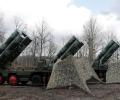
There has been a considerable drop in India's dependence on arms and equipment from Russia but the Indian military cannot operate effectively without Russian-supplied equipment and will continue to rely on its weapons systems in the near and middle terms, a Congressional Research Service report has said.

Two legislative amendments seeking a cut in the United States aid to Pakistan have been defeated in the House of Representatives with most lawmakers arguing that it is essential to maintain ties with a nuclear armed country despite it not doing enough in the war against terrorism.

He was ready even to take on Germany's collective guilt over the Holocaust

India's historical focus on its continental borders has overshadowed its maritime ambitions, but that is changing quickly, notes Ajai Shukla.

This is a national leadership gone so wrong that India's most powerful prime minister in four decades has personally taken charge of medical oxygen shortages, observes Shekhar Gupta.

If the initial analysis of this YJ-21 is correct, then China becomes the first country in the world to operationally field such a missile from a naval vessel.

While trying to persuade North Korea to give up its provocative actions, engaging China is the first hurdle that world leaders will have to deal with, says Rajaram Panda.
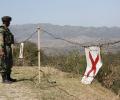
'The response to terror is not always reciprocal terror, nor is launching a conventional response the best response.' 'The best response is to make the sponsor pay a price he cannot afford,' says former RA&W chief Vikram Sood.
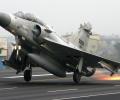
'If deterrence through India's conventional superiority is to be established now, then India will have to escalate to a point where its greater resources make the difference.' 'This is, to put it mildly, both difficult and dangerous and thus inadvisable,' points out Mihir S Sharma.

Internal strife and tribalism is endemic to Afghanistan, notes Colonel Anil A Athale (retd).

India's entry into the MTCR comes days after it failed to get Nuclear Suppliers Group membership due to stiff opposition from China and a few other countries.
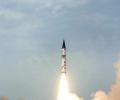
DRDO's latest test towards developing an anti-ballistic missile shield, to protect Indian targets against nuclear-tipped ballistic missiles fired from Pakistan or China will provide a technology that is akin to striking a bullet with a bullet, say Ajai Shukla

If the Taliban have proved one thing over these two decades, it is that they are way smarter than their big brother, observes Shekhar Gupta.
'If India employed a strategy of a 'thousand cuts', Pakistan will wither away.'

'I would urge my Indian friends to look at how significant the overall support was.'

If Manmohan Singh was hobbled by allegations of sleaze and a stagnant economy, Modi faces the twin challenges of high unemployment and an uncertain and potentially volatile situation in Kashmir, points out Amulya Ganguli.

During the day-long debate, the lines between science and religion often got blurred with many invoking religious texts and the contribution of 'rishi munis' to highlight India's tryst with the extra-terrestrial world.

'Even if the national security framework is to be threat-based, then the division of security threats between Pakistan and China is absurd. The two threats are one.'

If they can sit together and hammer out 'Black Sea Initiative' deal for much needed food shipments, surely, they should be able to address the madness of the larger military conflict?

What the Indian economy looks like next January will influence her view on India, not her genetics, notes Shekhar Gupta.

'A couple of hours before the H-Hour, the Kupwara division opened small arms and mortar fire on posts opposite its area of operation.' 'This was a diversionary tactic.' 'As Pakistani forces began to react to the firing, special forces teams began to slowly cross the LoC into PoK.' Nitin Gokhale reveals how planning for the surgical strikes began hours after the Uri attack.

'No matter how severe sanctions the UN security council imposes on North Korea, the impact of the sanctions would depend on how faithfully they are enforced by China,' says Dr Rajaram Panda.

'We have had 27 years of liberalisation and in the same period Korea and Japan and China transformed themselves forever,' says Aakar Patel.
'Dr Singh, visibly relieved, said, 'Yesterday night I couldn't sleep. I stayed awake, praying throughout. You have saved the country'.' A fascinating excerpt from former atomic energy chief Dr Anil Kakodkar's memoir Fire And Fury: Transforming India's Strategic Identity.
'China's actions at the NSG will certainly taint India-China bilateral relations and enhance suspicion of China's intentions. A fresh clear-eyed and objective evaluation of the India-China relationship is necessary, especially as India tries to correct adversely balanced bilateral economic ties and the two countries engage over the long-term,' says Jayadeva Ranade.

'The coming two months could unfold unpredictable results or unpredictable consequences or both at the same time,' says Rajaram Panda.

South Koreans learn how to talk to the enemy

'Taranjit has the ideal temperament to deal with the Americans who understand firmness and appreciate flexibility.' 'He can hold his ground with a cheerful face and still make it clear that India and the US are partners, rivals,' says Ambassador T P Sreenivasan.

On August 6 and August 9 of 1945, warfare changed forever when the United States dropped two atomic bombs on Japan, devastating the cities of Hiroshima and Nagasaki and killing more than 100,000 people. The attack on the people of Hiroshima at 8:15 a.m. on August 6, 1945, and the second attack on the city of Nagasaki at 11:02 am on August 9 killed and wounded hundreds of thousands of unsuspecting men, women, and children in a horrible blast of fire and radiation, followed by deadly fallout. In years that followed, those who survived -- the hibakusha -- suffered from the trauma of the experience and from the long-term effects of their exposure to radiation from the weapons. Before the blast, they were thriving cities. In a flash, they became desolate wastelands. Seventy-five years later, take a glimpse at the destruction.

To threaten China and Pakistan, and then to sharply cut back on military funding, bespeaks a remarkable trust in Beijing and Islamabad that is not borne out by anything they say or do, notes Ajai Shukla.
